Beloved English Professor and Scholar Jim Giles Remembered
By Michael Day
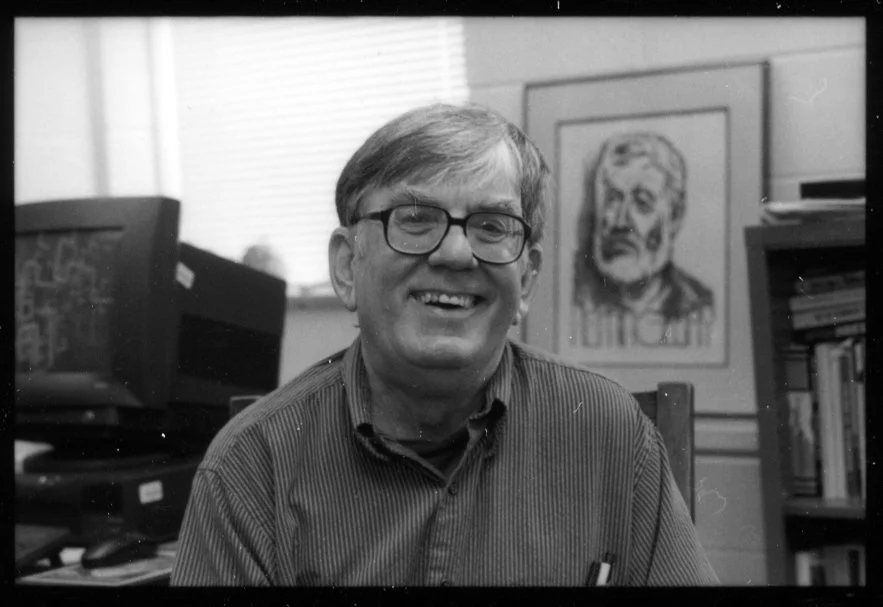
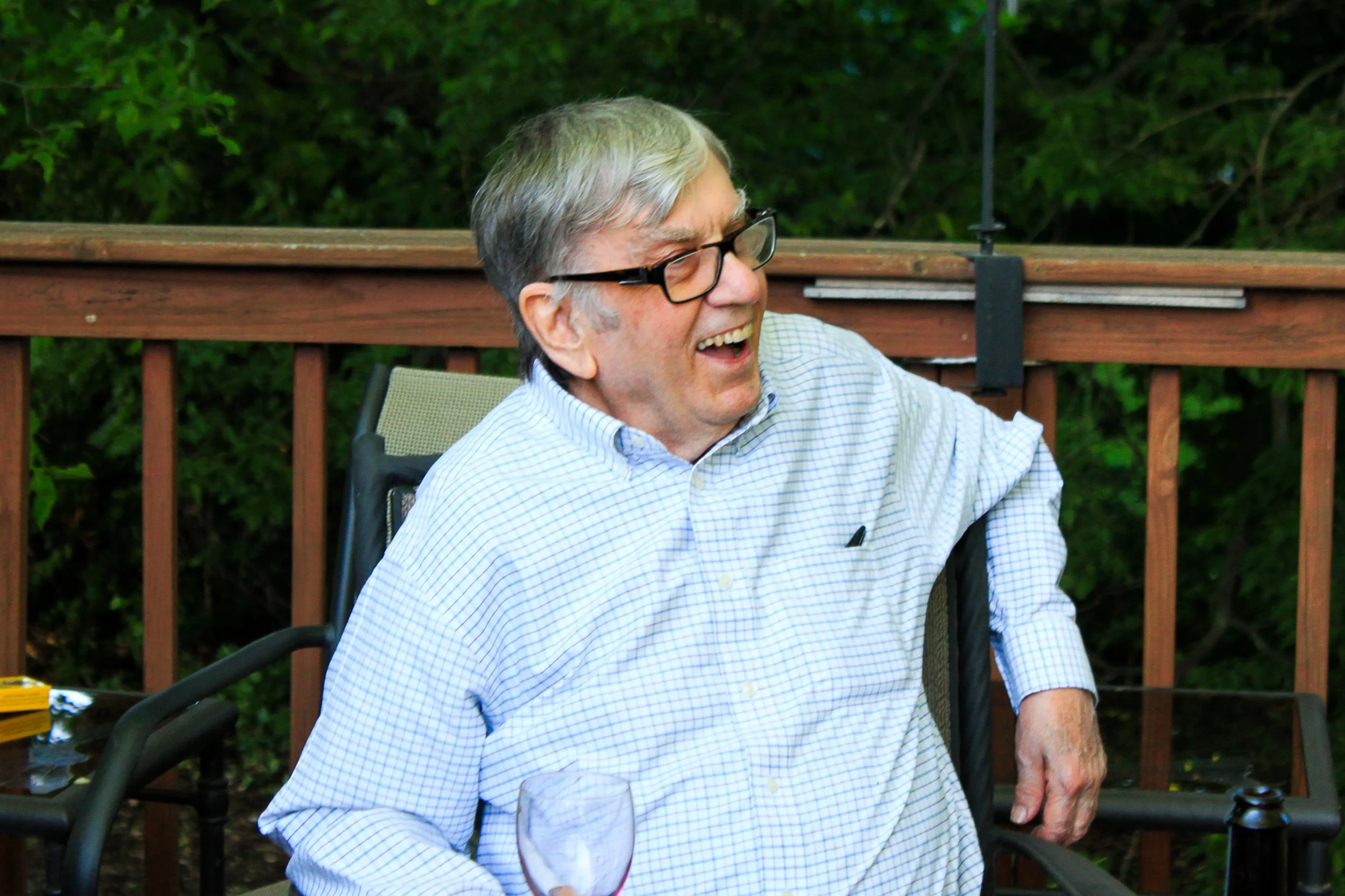
Even though he retired in 2007, many at NIU will remember Dr. James Richard Giles, who passed away on September 26th. Known to all as Jim, Jimmy, Giles, or Dr. Giles, this legendary NIU professor had a great gift not only for enlightening those around with great wisdom, but also for infecting them with fits of uncontrollable laughter. He was also a dedicated NIU leader, serving on key committees including the University Council (Executive Secretary 1985-87), the Faculty Senate (Chair 1986-88), and the Academic Planning Committee.
Born October 26, 1937, in Bowie, Texas, Jim graduated from Bowie High School in 1956. Even Jim’s high school classmates knew that he was destined to become a great writer. From the Bowie High School Class of 1956 yearbook: “Jimmy is Mrs. Davis’s Ernest Hemingway. He is a swell guy whose favorite pastime is laughing and making friends. He may be a great author someday, if the publishers can read his writing.”
As it turned out, Jim was a prolific academic writer and editor, with major influential publications including nine single-authored scholarly texts, six editions of the Dictionary of Literary Biographies co-edited with his wife Wanda, and countless articles in scholarly journals. Jim was widely hailed as an important voice in our understanding of American Literature; especially for his theory of “fourthspace” in his 2006 The Spaces of Violence, which, one scholar said, “establishes Giles as one of our most incisive and energetic critics of violence in late 20th-century American fiction.” For his many accomplishments in teaching, scholarship, and service, Jim was honored with the Excellence in Undergraduate Teaching Award in 2002 and named a Presidential Teaching Professor in 2004.
Jim and Wanda moved to DeKalb in 1970 to teach English at Northern Illinois University, where Jim was Professor of English until his retirement in 2007. Their daughter, Morgan Kathleen, was born in 1971. In the English Department, he served on or chaired countless thesis and dissertation committees, guiding students with care and unwavering support. His commitment to international colleagues was legendary: Jim was instrumental in securing a $182,000 Fulbright Grant to host English literature scholars from all over the world at an NIU summer institute and helping to lead this Fulbright Institute for several years.
Jim’s classes were in great demand, not only because he was a great lecturer and an expert on American literature, but also because he was a talented wit. According to one source, “Students and colleagues always leaned in to hear Jim, because they knew that if whatever he said wasn’t the most incisive comment they had ever heard, it would probably be the funniest.” One of Jim’s most famous students was Don Henley of the Eagles, who deemed Jim so inspirational to his success that he invited him to be his guest at the initiation of the Thoreau Institute at Walden Woods in 1998. There Jim met and had his photo taken with President Bill Clinton.
Jim’s family and friends remember him as an “extraordinary professor,” “an amazing human being,” “warm, encouraging, and funny,” “beloved among the graduate students,” and “admired for his scholarship, his teaching, and his kindnesses.” Some of his former students and colleagues had strong memories and effusive praise for him, quoted with permission.
And most of us remember all the years when Jim would hold court with Wanda at the Hillside Restaurant. He will be deeply missed.
Here are some individual remembrances of Jim.
Jim’s colleague, former English Department Chair Dr. Amy Levin, said that she had happy memories of going to Town House Books in St. Charles with Jim and Wanda to have dinner and hear Julia Glass read from her work. Levin continued: “Jim's most important gift to me was the theory of Fourthspace and its relation to violence. I applied it to what happens when museum exhibitions disturb visitors emotionally. The article questioned certain current trends in museums and has ended up being my most cited work.”
Jim’s former grad student Dr. Scott Stalcup, who took Jim’s Urban Novel class his second year of doctoral work, remembered:
He had the same appreciation for Coca-Cola in glass bottles I do. It got to be a ritual, even after I wasn't his student, that I'd bring him a bottle to sip during class. Of course, you can't talk about Jim without mentioning Wanda. Emailed him about course texts and she answered. She was from the same area I grew up and was one of the first to pronounce my surname correctly. They were two halves of a whole.
NIU English Professor Jeff Einboden was equally effusive in his praise:
It is impossible to express the momentous impact that Jim had upon his students, his colleagues, and the entire English Department. When I arrived in 2006, it was Jim who made me feel most at home in Reavis (…and way up on the 10th floor of Zulauf too!). A brilliant scholar who seemed to have read the entirety of American Literature, Jim was also incredibly generous and affable, putting all of us at ease with his signature wit and irony, his wry but always gentle humor. And although Jim retired at the end of 2007, his presence never left the Department. Rather, Jim became famed for his willingness to continue serving, remaining a beloved authority and mentor on countless dissertation committees many years after “officially” retiring, even while keeping current with the lives of all his friends in Reavis. In both his charity and passion, Jim was the very model of what the Humanities should be, and he will be tremendously missed.
Communications professor Ferald Bryan remembered serving with Jim at monthly meetings of the NIU Faculty Senate and University Council:
As Parliamentarian of both bodies, I always arrived early for these meetings. Jim was also there early, and we always had a wonderful conversation about the state of the University. He was very wise and experienced about university affairs and we shared a sincere concern about the future of our departments, our college, and the university. I missed these cheerful and thoughtful conversations before these meetings once Jim retired. I will always be grateful for the warmth and wisdom that he shared in our conversations. He will truly be missed.
Former student and current Slippery Rock State University Professor of Film Studies and Literary Criticism William Covey has kept up the Giles tradition with his own distinguished record of publication. He shared the following:
Dr. Giles may not realize the impact he had on me when I first encountered him as an undergraduate. It was 1980-1981 and the dominant majors at NIU were in the College of Business. I was a Business major and English minor myself, but I was floundering with courses, teachers, and fellow majors that I disliked. Then I took Professor Giles for one of his general American Literature courses. I loved his dry sense of humor, his self-deprecation, the slow build of his Texas storytelling style, his admission that he watched films and was obsessed with Hill Street Blues. I loved my first sustained exposure to American Naturalism. I was hooked. Because of Dr. Giles, I flip-flopped my plan of study, becoming an English major and a business minor. So, here's to Dr. Giles who, through his effective teaching style and strong knowledge of American literature, righted my path.
Emeritus Jacob and Lucile Fessler Professor of Creative Writing and Poet in Residence at Lakeland University Karl Elder remembered how Jim’s comments on work he submitted for class gave him the confidence to become a writer and professor:
I searched and found Jim's big, bold handwriting in red across the entire title page of a paper I was required to submit in his Black Lit. class, probably in '74: "A truly excellent paper in every way (analysis and writing) --you make the distinction between Bigger as 'a product of hatred' vs 'a man who hates’ extremely well (a short and completely telling answer to Baldwin). Your detailed account of the extent and significance of the white imagery is brilliant--talk to me about submitting this somewhere." Perhaps needless for me to add here is that those kind words tremendously influenced my confidence to pursue a career as a writer and professor of creative writing. I loved him especially for the way he listened to students.
Retired DeKalb High School teacher Anne Rukavina Williams also had good memories and praise for Jim:
Jim Giles was a kind, brilliant man. He, more than any of my instructors, informed my teaching. His seemingly meandering lectures, equal parts scholarship and witty anecdotes, always carried his students to a better understanding of the text at hand. Because of Professor Giles I became a better thinker and a better teacher. His respect for his students and his love for his subject matter inspired me. I cherish the copy I have of his The Naturalistic Inner-City Novel in America: Encounters With the Fat Man. I used it as reference in my teaching of naturalistic novels in my high school literature classes. He left a great legacy in his work and in his students. I felt lucky to have been in his classes.
Retired NIU English Department professor Steve Franklin and NIU Assistant Director of First-Year Composition Ellen Franklin also fondly remember Jim:
We first met Jim when we arrived in the fall of 1976. He had arrived several years earlier in the hiring boom of the late 60s/early 70s, one of the "Texas Mafia" that included Charles Hagelman, Jim Mellard, Craig Abbott, and later Heather and Don Hardy. We were among the many grad students who knew Jim as an excellent teacher. Steve's study of contemporary and modern American literature was enlarged by Jim's insistence that the canon required expansion to include minority authors.
At a time when grad students and faculty met each other often outside of Reavis, our rented farmhouses were frequently the venue. Steve, as EGSA president, planned receptions for visiting speakers and dissertation defense celebrations and Jim never missed these gatherings. Beloved by grad students, Jim never missed an occasion to spend time talking over a few beers and cigarettes. The Giles family added much to the NIU and DeKalb communities, and both Jim and Wanda are sorely missed.
Finally, no tribute to Jim would be complete without a few excerpts from former NIU English Professor Keith Gandal’s remarks at Jim’s retirement celebration in 2007:
For those who know Giles well, this day has a surreal quality for many reasons, not the least of which is that Giles has been talking about this retirement for as long as I have known him. And though I know he’s really retiring, some small part of me isn’t quite sure if this whole retirement thing isn’t a joke somehow perpetrated by him. I can’t say that he brought up the subject the very first time we met—but very soon after I was officially on campus, Giles began talking about his retirement. He would bring it up whenever something went wrong, even slightly wrong. For example, if he had a difficult class period, he would say to me, “I think it’s time for me to retire. It’s clear I’ve lost my stuff.” If a job search started to get hairy, he would mumble, “This is a sign that I should retire.” If a meeting proved harrowing, he would conclude, “Retirement is looking good.” If the elevator was malfunctioning in Zulauf, he would nod his head and comment, “I wouldn’t have to get up to the 10th floor if I were retired.” If he stubbed his toe on the steps in Reavis, he would muse, “I’m clearly getting too old for this sort of hazardous work.” Giles talked about retirement so much that when he actually told me, “I’ve been to talk to the Chair and the Dean about retiring,” I didn’t know how to take it. He had put the “boy who cried wolf” so to shame that I really wondered if he were joking.
We’ve been together in New Orleans, in New York, in Colorado. I’ve seen Giles on horseback, driving a racecar, celebrating Mardi Gras; I’ve seen him confront a grizzly bear with nothing more than a walking stick and a copy of Blood Meridian. Actually, I haven’t seen him doing any of those things. But I did watch him dream up the theme of our Fulbright Institute that won us the grant from the U.S. State Department; I watched him win over the hearts of scholars from all over the world; I’ve also watched him educate our graduate students with generosity and patience. Giles is a consummate scholar, a superb teacher, and an irreplaceable colleague. He’s read everything; he’s published a dozen books, and yet somehow he remains humble and approachable. He would leave a tremendous, really crippling void in this department if he were actually leaving. Thank God he’s not. Thankfully, he’s merely retiring.